
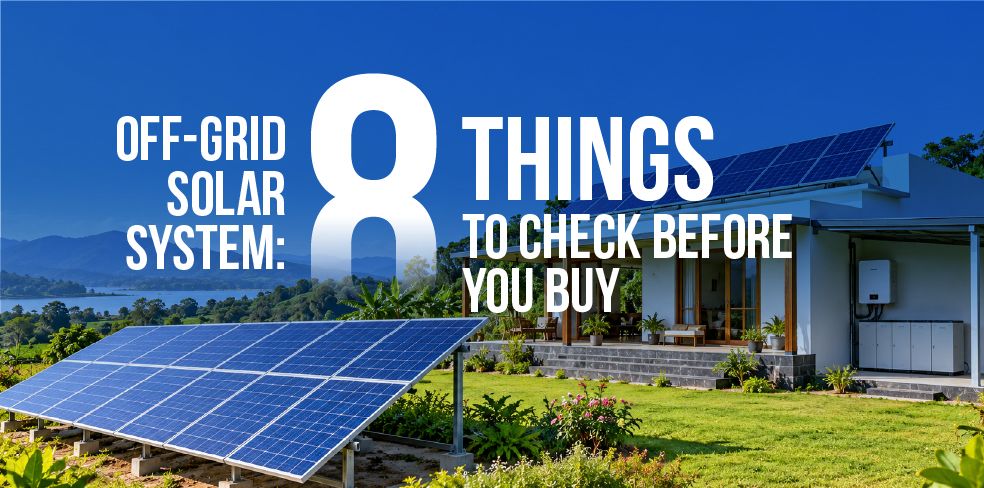
Is your farm or home paying for diesel and still facing power cuts? An off-grid solar system can end both problems. It makes its own electricity from sunlight and works with no link to the power company.
A standalone solar system is a big purchase, and a wrong size or a weak battery costs money for years. This guide gives you the eight checks to make first, the real price ranges in India, and a simple savings example, so you can decide with confidence.
What Is an Off-Grid Solar System?
An off-grid solar system is a complete power plant for one home, farm or workshop. Panels collect sunlight, batteries store energy, and you use it day or night. It needs no electricity board connection. This makes it the right choice where the grid is far away, weak, or often down.
-
Works with zero grid connection
-
Stores power in batteries for the night
-
Fits remote homes, farms, and cabins
-
You control your own power supply
8 Things to Check Before Installing an Off-Grid Solar System
Treat these eight checks as your buying list. Skipping even one can leave you with a system that is too small, too costly, or hard to repair.
1. Calculate Your Energy Needs:
Your daily power use decides the size of every part. Walk through your home or farm and note each appliance, its watts and its running hours. Guessing leads to blackouts or wasted money. A written list also gives installers what they need to quote accurately.
-
List fans, lights, fridge, pump and TV
-
Multiply watts by daily hours for each item
-
Add all totals to get daily watt-hours
-
Add 20% extra for future needs
2. Check Your Site's Solar Potential:
Sunshine is your fuel, so the site matters. Panels need clear, direct light for most of the day. A tall tree or a neighbour's wall can cut output sharply. A site visit shows what your roof or land can really produce in every season.
-
Count the full-sun hours your site gets
-
Look for shade from trees and buildings
-
Confirm the roof can carry the panel weight
-
Face panels south for the best yield
3. Choose Batteries and Inverter with Care:
Batteries and the inverter decide how long your system lasts. Lithium batteries cost more upfront but usually last longer than lead-acid ones. The inverter must handle your biggest load, such as a water pump starting up. Read our Topcon solar panel guide to pick panels that suit your budget.
-
Compare battery lifespan, not just price
-
Size the inverter for peak loads
-
Pick panels with proven efficiency
-
Buy matched parts with clear warranties
4. Plan for Backup Power:
Even a solar system with battery backup can run short after several cloudy days. A small backup source protects the things you cannot lose, such as the fridge and the water pump. You will run it far less than you do today.
-
A generator can top up batteries in bad weather
-
Size it for essential loads only
-
Add spare battery capacity for monsoon weeks
-
Keep key appliances on a separate circuit
5. Budget for Installation and Upkeep:
The panel price is only part of the cost. Add mounting, wiring, labour and transport. Then plan for yearly upkeep, such as cleaning panels and replacing batteries after several years. A full budget stops surprises halfway through the project.
-
Count equipment, labour and delivery
-
Keep a reserve for site work
-
Plan for battery replacement later
-
Budget for regular panel cleaning
6. Follow Local Rules:
Rules differ by state and local body. Some areas need permits, structure checks, or safety approvals before work starts. Skipping this can bring fines or force you to redo the work.
-
Check local building and safety codes
-
Get permits before work begins
-
Ask about state subsidy schemes
-
Keep all papers for insurance and resale
7. Use Professional Installers:
A DIY install looks cheaper but often costs more. Poor wiring can cause fires, shocks, and ruined batteries. Trained installers size the system to your real load, test it under full use, and back the work with a warranty.
-
Correct sizing from a site survey
-
Safe wiring, fuses and earthing
-
Testing under real load before handover
-
Warranty and service support after install
8. Leave Room to Grow:
Your needs will rise as you add a cooler, a pump, or a workshop. Design for that now, and you will not have to rebuild later. A modular design lets you add panels and batteries step by step.
-
Keep spare roof or ground space
-
Choose batteries that can be added to
-
Pick an inverter with extra capacity
-
Keep a copy of the system design
How an Off-Grid Solar System Works
The power moves along one fixed path from the sun to your socket. Knowing this path helps you find faults fast. If lights dim at night, check the batteries and inverters first. If batteries stay low during the day, check the panels and controller.
-
Panels turn sunlight into electricity.
-
The charge contrarieties 8 checks before you buy
-
Batteries store extra energy.
-
The inverter converts it into power for your lights, fans, and pumps.
Benefits of an Off-Grid Solar System:
The main gain is control. You make what you use, so outages and tariff hikes stop mattering. For farms and remote homes that run diesel generators, the savings also show up in fuel bills. Our guide on renewable vs nonrenewable energy explains the wider clean-energy gain.
-
No dependence on the power company
-
Protection from rising electricity rates
-
Lower fuel spending on generators
-
Quiet, clean power with no smoke
Cost of an Off-Grid Solar System in India
Price depends on system size, battery type and brand, and batteries are often the biggest share. These market ranges are a starting point. Your site survey gives the real quote. Always compare offers with the same battery and panel specifications.
| System Size | Approximate Price Range |
|---|---|
| 1 kW | ₹69,699 – ₹1,05,000 |
| 2 kW | ₹1,49,292 – ₹1,61,399 |
| 3 kW | ₹2,07,499 – ₹2,85,000 |
| 5 kW | ₹3,12,011 – ₹4,85,000 |
| 10 kW | ₹6,69,730 – ₹9,50,000 |
-
Lithium batteries raise the price but last longer
-
Bigger battery banks add the most cost
-
Wiring and mounting add to the total
-
Ask for a line-by-line quote
Best Locations for an Off-Grid Solar System
Sunny, dry regions give the best output, and remote sites gain the most because laying grid lines is costly. Farms are a clear case, as our guide to solar energy for agriculture shows. Extreme heat can trim panel output, so airflow behind panels helps.
-
High-sunshine regions such as Ladakh and Rajasthan
-
Sites with few clouds and little shade
-
Locations with easy access for repairs
-
Areas with active renewable energy programs
The Four Parts of an Off-Grid Solar Power System
Every off-grid solar power system has four core parts, and each has one job. They must be sized to match each other. A small battery paired with big panels wastes the extra power. Our solar energy equipment guide goes deeper into each part.
-
Solar panels: turn sunlight into electricity
-
Charge controller: stops batteries from overcharging
-
Battery bank: holds power for night and cloudy days
-
Inverter: changes stored power into home-ready current
Why Choose Soleos for Your Off-Grid Solar Installation
Buying solar is also a trust decision. You want a team that sizes honestly, installs safely and stays reachable. Soleos Energy handles the full job, from site surveys to commissioning and support. Read about how the sector is moving in our look at the factors shaping the future of solar energy.
-
122+ commissioned projects successfully delivered across rooftop, ground-mounted, and industrial sites.
-
114.3+ MW total capacity installed through an established global EPC framework spanning India, Africa, and Europe.
-
Industry-standard comprehensive project warranties, robust after-sales support, and performance monitoring tailored to commercial and utility installations.
-
Active project footprint extending across multiple regions in India, Africa, and Europe.
Conclusion:
A well-planned off-grid solar system gives you steady power, lower running costs and freedom from the grid. The key is to know your load, check your site, choose quality batteries, and use trained installers.
FAQs:
1. What is an off-grid solar system?
It is a solar setup that works without an electricity grid. Panels make power, batteries store it, and an inverter supplies your appliances.
2. How much does an off-grid solar system cost in India?
A 1 kW system starts at about ₹70,000. A 10-kW system can cost ₹7 lakh or more. Battery type and brand affect the final price.
3. Do I need batteries for an off-grid solar system?
Yes. Batteries store extra power for night and cloudy days. Without them, you only have power while the sun shines.
4. How long do off-grid solar batteries last?
Lead-acid batteries often last a few years, and lithium batteries usually last longer. Lifespan depends on the brand, how deeply you drain them, and upkeep.
5. Can I install an off-grid solar system myself?
It is possible but not advised. Wrong sizing or wiring can damage equipment and cause safety risks. Professional installers also protect your warranty.