
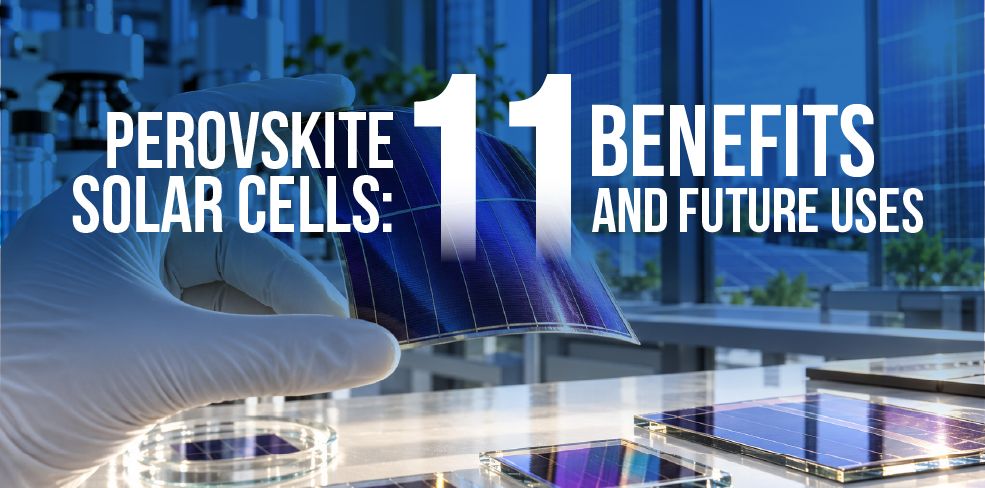
Solar technology continues to improve as researchers look for ways to generate more electricity from sunlight, reduce manufacturing costs, and use solar power in new places. One technology attracting attention is perovskite solar cells, which could make future solar systems lighter, more adaptable, and more efficient.
Unlike conventional solar cells, which mainly use silicon to capture sunlight, perovskite solar cells use a specially structured material that absorbs light effectively. Researchers are studying how this material can work on its own or alongside silicon to improve solar energy generation.
For businesses considering solar investments, understanding emerging technologies can help with long-term planning. However, it is equally important to distinguish promising laboratory results from technology that is ready for everyday commercial use.
What Are Perovskite Solar Cells?
Perovskite solar cells are solar cells that use a material with a particular crystal structure to absorb sunlight and convert it into electricity. The name comes from the mineral perovskite, although the materials used in solar cells are engineered compounds rather than necessarily being the natural mineral itself.
These materials are attracting attention because they can absorb light efficiently and can potentially be manufactured using processes that require less energy than some conventional manufacturing methods.
11 Potential Benefits of Perovskite Solar Cells
Perovskite solar technology offers several possible advantages, from improved energy conversion to new ways of integrating solar power into buildings and devices. The extent of these benefits will depend on continued research, manufacturing improvements, and successful commercial testing.
1. Potential for Higher Solar Cell Efficiency
Efficiency is one of the main reasons perovskite solar cells have attracted attention. Researchers have achieved strong laboratory results in a relatively short period, and combining perovskite with silicon may allow more sunlight to be converted into electricity.
For businesses, higher efficiency could eventually mean generating more electricity from a limited installation area.
Potential benefits include:
-
More electricity from a given surface area.
-
Better use of limited rooftop space.
-
Opportunities to improve the output of tandem solar cells.
-
Potential reductions in the area required for a given power target.
Actual energy generation will still depend on the finished module, installation conditions, temperature, shading, and system design.
2. Potential for Lower Manufacturing Costs
Some perovskite materials can be processed at relatively low temperatures, and researchers are exploring coating and printing methods for manufacturing them. These methods could simplify certain production steps.
However, lower material-processing costs do not guarantee that a complete panel will be cheaper. Quality control, protective packaging, production yields, and long-term reliability also affect the final cost.
Possible advantages include:
-
Lower energy requirements for some manufacturing processes.
-
Potentially simpler production methods.
-
Opportunities for manufacturing on different types of substrates.
-
Scope to reduce costs if production scales successfully.
Commercial costs will need to be demonstrated through reliable, large-scale production rather than laboratory results alone.
3. Lightweight and Thin Solar Designs
Perovskite solar cells can use thin active layers, and some designs may be manufactured on lightweight substrates. This could create options for surfaces that cannot easily support conventional glass-and-frame solar modules.
Possible applications include:
-
Lightweight structures where roof loading needs careful consideration.
-
Portable solar-powered equipment.
-
Selected building surfaces.
-
Specialised applications where weight is a major design factor.
A thin solar cell is not automatically a complete, weather-resistant panel. Encapsulation, mounting, electrical connections, and structural safety still need to be addressed.
4. Flexible Solar Applications
Some perovskite designs can be made on flexible materials, opening up possibilities beyond traditional rigid solar panels. This could help researchers develop solar products for surfaces that are curved or need a lightweight form.
Potential uses include:
-
Portable charging equipment.
-
Selected wearable electronics.
-
Curved surfaces and specialised structures.
-
Flexible power supplies for low-energy devices.
These applications remain dependent on the durability and electrical performance of the finished product. Flexible solar technology must also withstand repeated movement, environmental exposure, and normal use.
5. More Efficient Tandem Solar Cells
One of the most promising research directions is the perovskite-silicon tandem solar cell. In this design, two light-absorbing materials work together. Each layer can capture different parts of the sunlight spectrum, potentially generating more electricity than either layer could produce alone.
Why this matters:
-
It may increase the amount of sunlight converted into electricity.
-
It could improve output from a limited panel area.
-
It builds on the established role of silicon in solar technology.
-
It offers a route to higher efficiency without relying on a single material.
Research has demonstrated high efficiency in tandem cells, but commercial modules must also prove that they can be manufactured consistently and operate reliably over time. Learn more about solar module manufacturing.
6. Solar Windows and Building-Integrated Photovoltaics
Perovskite materials can be engineered for different levels of transparency and colour. Researchers are exploring how these properties could support building-integrated photovoltaics, where solar technology becomes part of a building’s windows, façades, or other surfaces.
Potential advantages include:
-
Generating electricity from selected building surfaces.
-
Making use of areas where conventional panels may not fit.
-
Offering more design choices for architects.
-
Combining building materials with electricity generation.
The amount of electricity generated will depend on transparency, available sunlight, orientation, and the design of the finished product. These systems also need to meet building and electrical safety requirements.
7. Opportunities for Agrivoltaics
Agrivoltaics combines agriculture and solar power on the same land. Researchers are exploring semi-transparent solar materials that could allow some sunlight to reach crops while producing electricity.
Potential opportunities include:
-
Using land for both agriculture and power generation.
-
Adjusting light transmission for specific crops.
-
Supporting farm operations with renewable electricity.
-
Exploring new designs for agricultural structures.
The right balance depends on crop type, local weather, the amount of light reaching plants, and the economics of the installation. Perovskite-based agrivoltaic systems should be evaluated as an emerging application rather than an established solution for every farm.
8. Shorter Energy Payback Potential
Energy payback time is the period a solar system needs to generate the amount of energy used to manufacture, transport, and install it. Some perovskite manufacturing methods may require less process energy, which could help reduce this period.
Possible advantages include:
-
Lower manufacturing energy requirements.
-
Potential improvements in the energy balance of solar production.
-
Opportunities for more resource-efficient manufacturing.
-
Further reductions in lifecycle environmental impacts if durability improves.
A fair comparison must consider the entire product lifecycle. If a panel needs replacing sooner than a conventional panel, that replacement could offset some of its manufacturing advantages.
9. Potential Use in Indoor and Low-Light Applications
Perovskite materials can be adjusted to absorb different parts of the light spectrum. This has led to research into indoor energy harvesting and applications where light levels or angles differ from typical outdoor conditions.
Potential applications include:
-
Small sensors.
-
Low-power electronic devices.
-
Selected indoor monitoring equipment.
-
Specialised devices that need supplementary power.
Performance under indoor lighting varies with the light source, intensity, and cell design. These applications should not be confused with the requirements of a large outdoor solar plant.
10. Lightweight Solar Technology for Space
Spacecraft need reliable electricity while keeping weight as low as possible. The potential combination of high efficiency and low weight makes perovskite solar cells an area of interest for space-related research.
Researchers are investigating factors such as:
-
Performance under radiation exposure.
-
Resistance to temperature changes.
-
Stability during extended operation.
-
Weight and power output.
Space applications have demanding reliability requirements. A promising laboratory cell must pass extensive testing before it can be trusted in a mission.
11. Research Into Lead-Free Alternatives
Many perovskite solar cell designs use lead-containing compounds, which raise questions about handling, product safety, and disposal. Researchers are studying alternatives, including tin-based materials, to reduce or eliminate the use of lead.
Important research priorities include:
-
Developing materials with lower environmental risk.
-
Improving the stability of alternative compounds.
-
Maintaining useful electrical performance.
-
Designing safe manufacturing, recycling, and end-of-life processes.
Lead-free versions are not automatically as efficient or durable as existing designs. Environmental benefits must be assessed across the product lifecycle, including how materials are recovered and managed.
How Do Perovskite Solar Cells Work?
Perovskite solar cells follow the same basic principle as conventional photovoltaic cells: they capture sunlight and turn it into electrical energy. The difference lies in the light-absorbing material and the way the cell is designed to move electrical charges.
Here is the process in simple terms:
-
Sunlight reaches the cell: Light enters the perovskite layer.
-
The material absorbs light: The absorbed energy excites electrons, creating mobile electrical charges.
-
The charges separate: Layers inside the cell direct electrons and positive charges along different paths.
-
Electricity flows: The movement of electrons through an external circuit creates an electric current.
Think of the cell as a system that captures sunlight and directs the resulting electrical charges into a usable flow of energy.
Four important points explain why researchers are interested in this process:
-
Perovskite materials can be designed to absorb different parts of the sunlight spectrum.
-
The active light-absorbing layer can be very thin.
-
Other materials and layers help collect the electrical charges.
-
The complete device must protect the sensitive material while maintaining performance over time.
The efficiency of a solar cell measures how much of the sunlight reaching it is converted into electricity. However, a high laboratory efficiency does not automatically mean a finished solar panel will deliver the same performance throughout its operating life.
Where Could Perovskite Solar Technology Be Used?
The future uses of perovskite solar cells will depend on how well researchers solve the challenges of stability, scale, and cost. Different applications may become practical at different times.
Potential areas of development include:
-
Tandem solar modules: Combining perovskite with silicon to increase conversion efficiency.
-
Building-integrated photovoltaics: Incorporating solar materials into windows, façades, or roofing elements.
-
Portable electronics: Exploring lightweight cells for low-power devices.
-
Agricultural installations: Testing semi-transparent materials for combined crop production and electricity generation.
These possibilities do not mean every application is commercially ready today. Product availability, warranties, certification, and operating data should guide purchasing decisions.
What Does the Future Hold for Perovskite Solar Cells?
Perovskite solar cells could become an important part of future solar technology if researchers can improve durability and manufacturers can produce reliable modules at scale. Tandem cells are a particularly promising direction because they combine the strengths of different light-absorbing materials.
Progress will depend on several factors:
-
Better stability: Cells must retain performance through years of real-world use.
-
Scalable manufacturing: Production needs to be consistent and commercially viable.
-
Safety and recycling: Materials must be managed responsibly throughout the product lifecycle.
-
Independent validation: Buyers need trustworthy evidence of performance, reliability, and cost.
Businesses do not need to wait for every emerging technology before evaluating solar power. Established solar solutions can already help suitable facilities manage electricity costs, while newer technologies continue to develop.
If you are exploring solar for a factory, warehouse, commercial building, or larger site, start with your electricity use, available space, project economics, and expected operating needs. Explore commercial solar energy options to understand the considerations involved in planning a project.
FAQs:
1. Are perovskite solar panels commercially available?
Some perovskite-based products and pilot efforts are emerging, but the technology is not yet as widely established as conventional silicon modules for mainstream solar power generation. Buyers should verify the specific product’s availability, certification, warranty, and operating history.
2. Are perovskite solar cells more efficient than silicon panels?
Perovskite cells have achieved high efficiencies in laboratory testing, and perovskite-silicon tandem cells have demonstrated even higher results. However, laboratory records do not necessarily represent the performance of commercial modules over their full operating life.
3. Can businesses use perovskite solar cells for industrial projects today?
Businesses should assess commercially available products and independently verified performance before selecting a technology. Conventional silicon modules remain the more established option for most industrial solar projects, while perovskite technology continues to develop.