
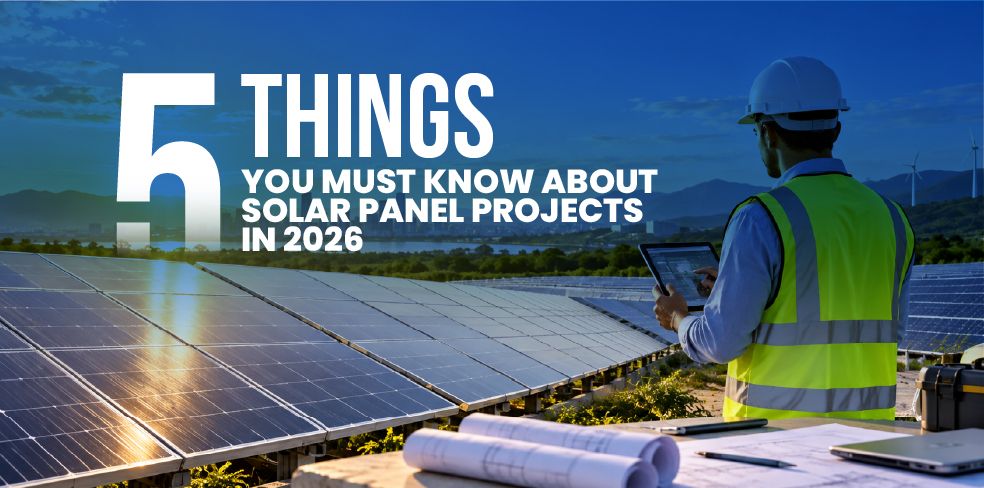
Electricity tariffs keep rising, and grid supply is not always steady. That is why more factories, warehouses and commercial sites now treat solar as core infrastructure rather than a nice extra. Solar panel projects give you a fixed, predictable power cost for 25 years or more.
Solar panel projects in 2026 come with a new rule to plan around. India's domestic-cell requirement (ALMM List-II) now affects which panels you can use. This guide covers the five things that decide whether your project pays off: technology, project type, cost, savings and execution.
What Are Solar Panel Projects?
Solar panel projects are complete solar systems built for businesses, factories and large sites. They cover design, installation and long-term maintenance. They go well beyond just fitting panels on a roof.
-
Solar panels: turn sunlight into electricity
-
Inverters: convert that electricity into a form your equipment can use
-
Mounting structures: hold panels safely on roofs or land
-
Cables and safety systems: connect and protect the plant
-
Monitoring and maintenance: track output and fix faults early
-
Optional batteries: store power for evenings and outages
1. Pick the Right Panel Technology
Panel technology decides how much power you get from each square metre. That matters most when roof space is limited. In 2026, three types dominate.
| Technology | Typical efficiency | Best for |
|---|---|---|
| TOPCon | 22–23%+ | Most factory rooftops and solar parks, especially in hot regions |
| HJT | Up to about 25% | Limited roof space, dusty or hot sites |
| Mono PERC | 19–21% | Tight budgets and medium rooftops |
Bifacial panels, which collect light from both sides, add another 5–25% output. They are now standard on most ground-mounted plants. Higher-efficiency panels can cost slightly more upfront, but they degrade slower and earn more over time.
2. Match the Project Type to Your Site
The right layout depends on your space, power demand and budget. Each option suits a different kind of site.
-
Rooftop solar: no land needed, fastest to build, and quick payback. Good for factories with strong roofs.
-
Ground-mounted solar: easy to expand and high output, but it needs land and longer approvals. Good for energy-heavy industries.
-
Solar carports: turn parking lots into power plants while shading vehicles. Good for campuses and corporate parks.
-
Agrivoltaics: crops or livestock below the panels, so land earns twice. Good for sites with farmland.
See all behind-the-meter options on our onsite solar solutions page.
3. Know What Drives Solar Project Cost
Price per watt alone does not tell you what a project really costs. Six factors shape the final number, and quality shortcuts usually cost more later.
-
Panel technology: the biggest lever on long-term returns
-
Project type: ground-mount needs foundations and grid connection; rooftops mostly do not
-
Inverters: usually 5–15% of total cost, but critical to reliability
-
Mounting and cabling: cheap materials raise maintenance costs
-
Site conditions: soil, shading, wind and distance to the grid
-
Execution quality: good engineering cuts energy losses and rework
Ask for a line-by-line quote (Bill of Quantities) so you can see every cost and exclusion before you sign.
4. Understand Your Savings, Payback and Policy Support
Solar cuts your power bill from day one. Commercial systems often reduce electricity costs by 20–40%, depending on your load and tariff. Rooftop projects usually pay back in 3–5 years.
-
Lower upfront cost: India cut GST on solar modules and components from 12% to 5%
-
Flexible metering: net, gross, virtual and group metering let you earn credit for extra power
-
Zero-investment models: the RESCO/OPEX route needs no upfront spend
-
Captive and open-access options: suit large power users who want tariff certainty
-
Domestic-cell rule (ALMM List-II): since 1 June 2026, net-metered and open-access projects must use modules with cells from approved Indian makers. Some projects have a relief window until 31 December 2026, so confirm your commissioning date in writing.
The new rule can add a little to module cost in the short term. Planning early and locking in compliant supply protects your timeline and budget. Choose a financial model that fits your cash position: CAPEX for maximum long-term savings, RESCO for instant savings, or group captive for scale.
5. Plan the Build and Demand Strong O&M
A solar plant only performs well if it is built and maintained well. Good execution protects your returns for decades.
How to run a solar project, step by step:
-
Set your goal: lower bills, energy security or ESG targets
-
Survey the site: roof strength, shading and hourly power use
-
Choose your technology and system size
-
Pick a financial model (CAPEX, RESCO or captive)
-
Secure grid and regulatory approvals, including ALMM compliance
-
Build, test and commission the plant
-
Track generation, savings and carbon reduction
What to demand in your O&M contract:
-
Generation guarantees with penalties for underperformance
-
24/7 remote monitoring with automatic fault alerts
-
Cleaning plans, since dust can cut output by 5–15%
-
Regular inverter and cable checks
-
Clear monthly reports showing savings, not just technical data
Rooftop, ground-mount or carport, the same rule applies: pick an experienced solar EPC partner that handles design, build and maintenance under one roof. Our guide on the benefits of commercial solar energy shows how this plays out for businesses.
Conclusion
The best solar panel projects in 2026 start with the right panel, the right layout and honest costing. They finish with strong maintenance. Get those five things right and solar becomes a steady source of savings, not just a green label.
FAQs:
1. What are solar panel projects?
Solar panel projects are complete solar power systems built for businesses and industries. They include design, panels, inverters, installation and maintenance. They can be rooftop, ground-mounted, carport, or captive and open-access setups.
2. Which solar panel technology is best for a factory in 2026?
TOPCon is the most common choice for factories because it balances efficiency, cost and heat performance. HJT suits sites with very limited roof space or dusty, hot conditions. Mono PERC works for tighter budgets.
3. How much can a business save with solar?
Most commercial solar systems cut electricity costs by 20–40%. Your exact saving depends on your power use, local tariff and project type.
4. What is the payback period for a solar project?
Rooftop solar projects usually pay back in 3–5 years under the CAPEX model. Under the RESCO or OPEX model, you pay nothing upfront and save from the first month.
5. How do I choose a solar EPC partner?
Look for proven industrial projects, Tier-1 components, transparent costing and long-term O&M support. Ask for generation data from past plants and written confirmation that your modules meet ALMM rules.