
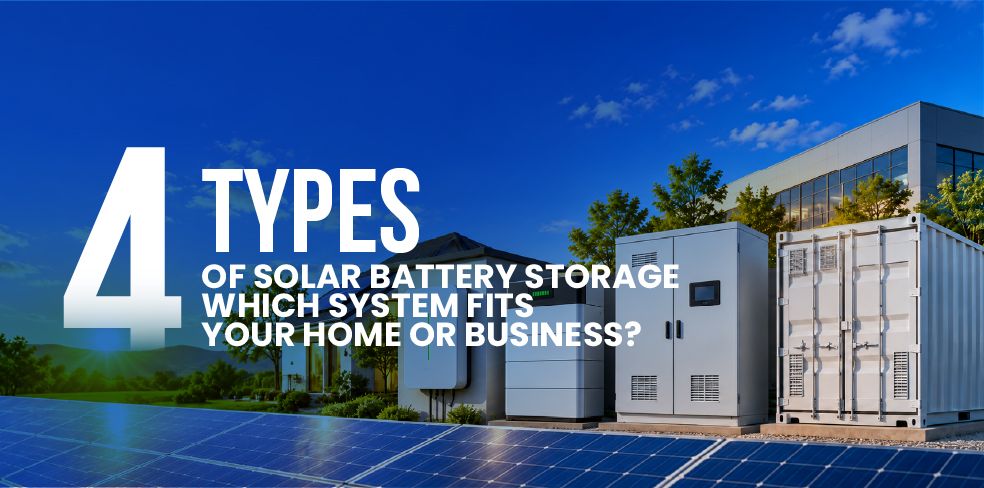
Solar panels only pay off fully when the power they make actually gets used. The problem is, most homes use the least electricity right when the sun is strongest - during the middle of the day, when everyone is at work or school. A solar battery storage system fixes this mismatch. It saves the extra power your panels produce during the day so you can use it at night, during a power cut, or whenever electricity rates go up.
Choosing the right type of solar battery storage makes a real difference to how much you save every month. In this guide, we'll explain the four main types of solar batteries in plain language, show you real 2026 pricing in India, and walk you through a simple way to pick the right one for your home or business.
What Is Solar Battery Storage, in Simple Terms?
Think of a solar battery like a savings account for electricity. During the day, your panels often make more power than you can use right away. Without a battery, that extra power gets sent back to the grid, and you get paid very little for it. With a battery, that same power gets stored at home instead, ready whenever you need it. Here's how the process works, step by step:
-
Your solar panels turn sunlight into electricity.
-
A device called an inverter changes that electricity into a form your home appliances can use.
-
Any power you're not using right away gets sent into the battery instead of the grid.
-
When the sun goes down, or during a power outage, the battery releases that stored power to keep your lights, fridge, and other essentials running.
Why Homeowners and Businesses Are Adding Battery Storage
Before we get into battery types, it helps to understand why so many solar owners are adding storage in the first place.
-
Lower electricity bills: Use your own stored solar power instead of buying expensive grid electricity during peak hours.
-
Backup during power cuts: A charged battery keeps essential appliances running when the grid goes down.
-
Less energy waste: A battery lets you use power your panels would otherwise sell back cheaply.
The 4 Main Types of Solar Battery Storage
Not every solar battery works the same way. Each type is built from different materials and suits a different budget, purpose, and property size. Here's a simple breakdown of the four most common options.
1. Lithium-Ion Batteries
Lithium-ion is by far the most popular choice for homes today. It's the same battery technology used in smartphones and laptops, just scaled up for home energy use, and it stores a lot of power in a small, lightweight unit.
-
Lasts around 10 to 15 years with very little maintenance required.
-
Can safely use 80% to 100% of its stored power without wearing out early, unlike older battery types.
-
Small and light enough to mount on a garage or utility room wall, which makes it a good fit for most homes.
Brands like Tesla Powerwall and Enphase IQ are well-known examples of this battery type, and they're a common choice for residential solar battery storage systems across India.
2. Lead-Acid Batteries
Lead-acid batteries are the older, more affordable option. They come in two forms — flooded (which need regular topping up with water) and sealed (lower upkeep). They're bulkier than lithium-ion and don't last as long, but the lower price makes them attractive for tight budgets.
-
Typically lasts 5 to 7 years, noticeably shorter than lithium-ion.
-
Needs more regular maintenance, especially the flooded type.
-
Common in off-grid rural homes and as simple backup power during outages.
3. Flow Batteries
Flow batteries work differently from the others here. Instead of solid materials, they use a liquid solution that flows through the system, similar to water moving through a pipe. This lets them be fully drained and recharged without wearing out.
-
Can be discharged completely (100%) without damaging the battery, unlike lithium-ion or lead-acid.
-
Built to last 15 years or more with strong reliability over time.
-
Mostly used for large commercial and utility-scale projects rather than homes, because they're bulky and expensive.
4. Nickel-Cadmium Batteries
Nickel-cadmium batteries are the toughest of the four. They can handle extreme heat and cold far better than any other type here, which makes them useful in demanding industrial settings - but that toughness comes at a high price, and they're rarely used in homes.
-
Can last up to 20 years, the longest lifespan on this list.
-
Performs reliably in very hot or very cold climates where other batteries would struggle.
-
Mostly found in industries like aviation and large-scale manufacturing, not residential solar.
How to Choose the Right Solar Battery for You
Picking a battery isn't about buying the biggest or most expensive option - it's about matching the battery to how you actually use electricity. Here's a simple way to think it through.
-
Look at your daily electricity use first. Check a few of your past electricity bills to see how many units (kWh) you use each day on average. For example, if your home uses about 30 kWh per day, a 10 kWh battery would cover roughly a third of that.
-
Decide what you want backed up. Do you want the battery to power your entire home during an outage, or just essentials like lights, the fridge, and a few fans? This decision has a big effect on the battery size and cost - you'll need.
-
Check that your inverter can work with it. Not every battery works with every solar inverter. If you already have solar panels installed, confirm your current inverter supports the battery type you're considering, or budget for a hybrid inverter that can handle both.
Cost of Solar Battery Storage in India (2026)
Prices vary quite a bit depending on the battery type, its size, and the brand you choose. Here's a simple breakdown to help you budget.
| Battery Type | Capacity | Price Range (INR) | Typical Lifespan |
|---|---|---|---|
| Lead-Acid | 1–10 kWh | ₹10,000 – ₹1,50,000 | 5–7 years |
| Lithium-Ion | 2–15 kWh | ₹50,000 – ₹7,00,000 | 10–15 years |
| Flow Battery | 5–20 kWh | ₹5,00,000 – ₹10,00,000 | 15+ years |
On top of the battery itself, expect to budget for a compatible inverter (₹50,000–₹2,50,000) and professional installation (₹10,000–₹50,000). It's a real upfront investment, but here's the part that matters most: most homeowners see their system pay for itself within 4 to 6 years through lower monthly bills. After that point, you're essentially storing and using free electricity for the rest of the battery's lifespan - often another 6 to 10 years, depending on the type you chose.
If you're planning storage for a larger commercial or industrial site rather than a home, the numbers and considerations shift quite a bit - our industrial solar solutions guide breaks down battery sizing at that scale in more detail.
Government Incentives That Can Lower Your Costs
The Indian government has been putting real money behind battery storage in recent years, on top of the incentives already available for solar panels themselves.
-
A national incentive scheme worth roughly $452 million is aimed at supporting 4,000 MWh of new battery storage capacity across the country.
-
The Production Linked Incentive (PLI) Scheme for high-efficiency solar panels has allocated 39,600 MW of domestic manufacturing capacity, which is gradually helping bring equipment costs down.
-
State-level subsidies for battery storage are becoming more common alongside existing solar subsidies, so it's worth checking what's currently available in your state before you finalize a budget.
For more on how India's solar landscape is shaping up this year, our 2026 guide to solar panel projects covers the bigger picture beyond just storage.
FAQs:
1. Which type of solar battery is best for home use?
For most homes, lithium-ion is the best fit. It's compact, needs almost no maintenance, and gives you the most usable power for the space it takes up - even though it costs more upfront than lead-acid.
2. How long do solar batteries actually last?
It depends on the type. Lithium-ion batteries typically last 10 to 15 years, lead-acid batteries last 5 to 7 years, and flow or nickel-cadmium batteries can last 15 to 20 years or more.
3. Can a solar battery power my whole house during a power cut?
Yes, if it's sized correctly for your home's needs. That said, many households choose to back up only essential appliances — like lights, the fridge, and Wi-Fi - to keep the battery size, and cost, more manageable.
4. Is solar battery storage actually worth the extra cost in India?
For most homeowners, yes. With electricity savings of 30% to 70% and a typical payback period of just 4 to 6 years, the system usually pays for itself well within its working lifespan.
5. Do I need a special inverter for solar battery storage?
In most cases, yes. You'll need either a battery-compatible inverter or a hybrid inverter that can manage both your solar panels and your battery's charging and discharging in one unit.