
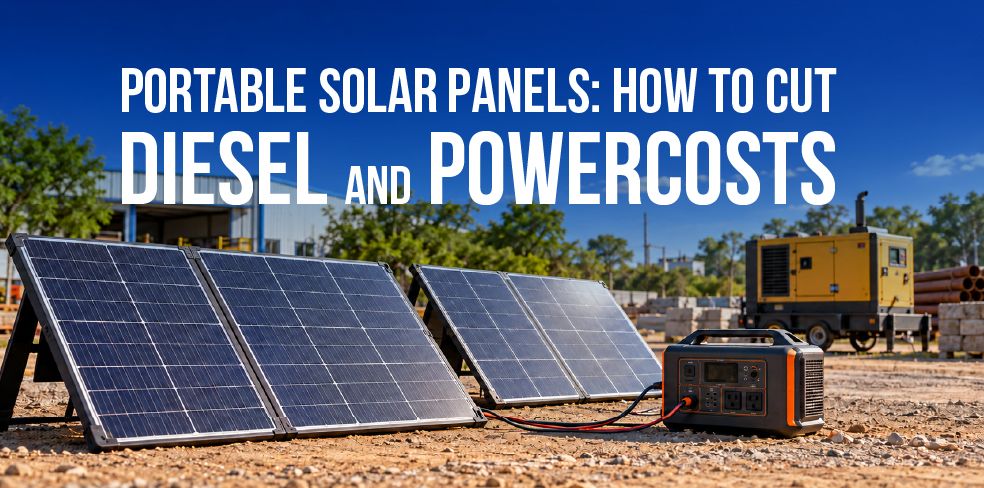
Portable solar panels turn sunlight into electricity you can carry to any site. They replace diesel generators and costly extension lines with free daylight.
Farms, work sites, and small businesses now use portable solar power to run pumps, lights, and tools. Foldable solar panels also suit campers and travelers. This guide shows how much you can save, which type to buy, and when to move to a bigger system.
What Are Portable Solar Panels?
Portable solar panels are compact units you can fold, carry, and set up in minutes. Silicon cells capture sunlight and make direct current (DC) power. You connect the panel to a battery or power station to run your devices. Unlike rooftop systems, you can move them wherever power is needed.
-
Weigh far less than rooftop panels
-
Need no wiring or permanent installation
-
Charge batteries, phones, and small tools
-
Work anywhere sunlight reaches
How Do Portable Solar Panels Work?
Sunlight hits the solar cells and knocks electrons loose, which creates an electric current. A charge controller keeps that current steady so it does not damage the battery. If you need to run normal appliances, an inverter converts the stored DC power into alternating current (AC).
-
Solar cells collect sunlight during the day
-
The charge controller protects the battery
-
The battery stores power for evenings and cloudy hours
-
The inverter powers AC tools and appliances
Who Saves the Most with Portable Solar Panels?
Savings are highest where people burn diesel or pay for remote power lines. A farm pumping water, a site running floodlights, or a shop facing frequent outages all spend more than they realize. Campers save too, but on a smaller scale. The more hours you run a generator, the faster solar pays back.
-
Farmers running pumps and field lights
-
Construction and remote site teams
-
Small shops facing frequent power cuts
-
RV, van, and camping users
Types of Portable Solar Panels
Panel type decides weight, price, and power output. Your use case should guide the pick. Travelers want light panels, while farms and sites want sturdier, higher-output units. Match the type to how often you move the panel and how much power you need.
-
Monocrystalline: highest efficiency, best when space is limited
-
Polycrystalline: lower cost, slightly lower output
-
Thin-film and rollable: very light and flexible, but lower power
-
Rigid and foldable kits: strong for sites, easy to carry
Cost Benefits of Portable Solar Panels
The savings go beyond fuel. A generator needs oil changes, repairs, and a steady fuel supply, while a solar panel has no moving parts. Over several years, that difference has been added. Portable panels also keep your work running during outages, which protects income. They are a practical step into cleaner, cheaper energy.
-
No fuel purchase or transport costs
-
Very low servicing and repair needs
-
Backup power that protects work during outages
-
Silent, emission-free operation
Where Can Businesses Use Portable Solar Panels?
Portable panels fit any place where grid power is costly, weak, or missing. Farms use them for water pumps and fencing. Work sites use them for lights and battery tools. Shops and small offices use them as backup for billing systems and lighting. Each use replaces fuel or protects against downtime.
-
Irrigation pumps and field lighting on farms
-
Floodlights and tool charging at construction sites
-
Billing, lighting, and CCTV backup in shops
-
Mobile clinics, events, and remote camps
How to Choose the Right Portable Solar Panel
Start with the devices you must power, then add up their watts. Buy panels that cover that load with some spare capacity. Check build quality, since panels face dust, rain, and rough handling. Compare options against the full solar energy equipment you will need, including batteries and controllers.
-
Calculate your load: add up the watts of every device
-
Check efficiency: advanced cells such as TOPCon solar panel technology give more power per size
-
Check durability: look for weatherproof frames and a solid warranty
-
Confirm compatibility: match ports, voltage, and battery type
Common Buying Mistakes That Waste Money
Many buyers pick a panel by price alone and end up with too little power. Others buy a huge panel they never use fully. Skipping the battery is another costly error, because panels alone cannot supply power at night. A little planning avoids paying twice.
-
Buying too small and still running the generator
-
Buying too large and paying for unused capacity
-
Ignoring battery size and night-time needs
-
Choosing unknown brands with no warranty support
How to Keep Your Savings High
A dirty or badly placed panel loses power, which cuts your savings. Clean the surface, face it toward the sun, and keep it free of shade. Store it dry after use. Small habits protect your investment and extend panel life.
-
Wipe dust with a soft cloth and mild soap
-
Angle panels toward the sun through the day
-
Avoid shade from trees, tents, or vehicles
-
Store dry and check cables before each use
When Portable Solar Panels Are Not Enough
Portable panels handle small loads, usually 20 to 300 watts each. Running a full farm, factory, or warehouse needs a permanent system. Moving up cuts costs at a much larger scale and removes the daily setup work. Know your limit before you spend on the wrong size.
-
Farms with large irrigation needs: see solar energy for agriculture
-
Remote homes or sites needing full power: an off-grid solar system
-
Factories and warehouses: industrial solar solutions
-
114.3 MW of installed clean energy across 122+ completed projects serving agriculture, C&I manufacturing, and utility clients in India, Africa, and Europe.
FAQs:
1. Are portable solar panels worth it?
Yes, if you run a diesel generator or lack steady grid power. The fuel savings can repay the cost within one to two years.
2. How many watts do I need?
Phones, lights, and small tools need 50 to 100 watts. A pump or small fridge needs 200 watts or more, plus a battery.
3. Can portable solar panels run a water pump?
Small pumps can run on a large panel and battery. Bigger irrigation pumps need a permanent solar pumping system.
4. How long do portable solar panels last?
With care, most last 10 to 25 years. Cables and hinges usually wear first.
5. When should I switch to a bigger solar system?
Switch when your daily power need passes what portable panels can supply, or when you set up panels every day.