
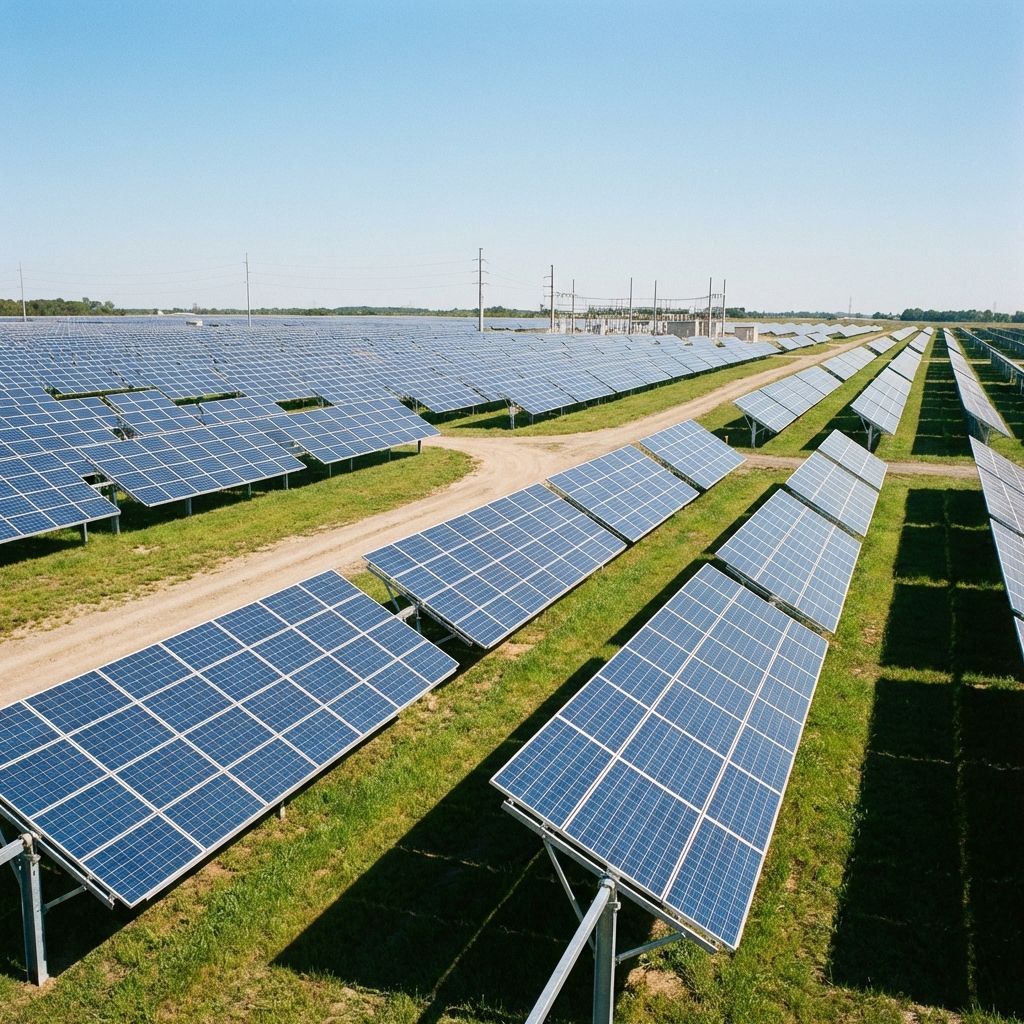
In the race toward a cleaner, greener planet, solar energy is taking center stage. While rooftop systems have gained popularity, another powerful and versatile solution is making waves across industries and open landscapes — Ground Mounted Solar Panel Systems.
At Soleos Solar Energy, comprehensive solar EPC services are delivered across India and international markets, with extensive experience in large-scale ground-mounted solar projects for commercial and industrial sectors. :contentReference[oaicite:0]{index=0}
- What is a Ground Mounted Solar Panel System?
- Types of Ground Mounted Solar Panel Systems
- Benefits of Ground Mounted Solar Panel Systems
- Ideal Applications
- Installation Process
- Cost of Ground Mounted Solar Systems
- ROI and Payback Period
- Ground Mounted Solar vs Rooftop Solar
- Government Policies Supporting Ground Mounted Solar
- Why Choose Soleos Solar
- Frequently Asked Questions
- Conclusion
A ground mounted solar panel system is a solar installation where photovoltaic (PV) panels are installed directly on the ground rather than on rooftops.
These systems are supported by mounting structures fixed into the ground and can be designed to optimize sunlight exposure and energy generation. Ground-mounted installations are especially suitable for properties with sufficient open land and high energy requirements. :contentReference[oaicite:1]{index=1}
Key Features
Installation Flexibility
Ground-mounted systems can be installed wherever adequate sunlight and open space are available.
Optimal Sunlight Exposure
Panels can be positioned at the ideal angle and orientation to maximize solar energy production.
Scalability
Additional panels can easily be added as energy requirements grow.
Easy Maintenance
Ground-level access simplifies cleaning, inspections, and repairs.
1. Standard Fixed-Tilt Systems
Features
- Fixed panel orientation
- Cost-effective solution
- Low maintenance requirements
- Suitable for locations with consistent sunlight
2. Single-Axis Tracking Systems
Features
- Follow the sun from east to west
- Increase energy generation
Benefits
- 15–25% higher efficiency than fixed systems
3. Dual-Axis Tracking Systems
Features
- Track both horizontal and vertical sun movement
Benefits
- Up to 35% higher energy output
- Maximum solar exposure
Consideration
- Higher installation and maintenance costs
4. Agrivoltaics (Agri-Solar)
Agrivoltaics combines agriculture and solar energy generation.
Benefits
- Solar panels installed above crops
- Dual use of land
- Additional income for farmers
- Improved land productivity
5. Solar Carports
Features
- Ground-based structures over parking areas
- Provide vehicle shade
- Generate clean electricity
Common Applications
- Industrial parks
- Commercial complexes
- Corporate campuses
1. Enhanced Efficiency
Ground-mounted systems can be positioned at ideal tilt angles and orientations, resulting in higher energy generation compared to many rooftop systems.
2. Improved Accessibility
Maintenance activities such as:
- Cleaning
- Inspection
- Repairs
are easier and safer because panels are accessible at ground level.
3. Design Flexibility
Ground-mounted systems can:
- Accommodate irregular land shapes
- Utilize tracking technologies
- Optimize energy production
4. Reduced Risk of Roof Damage
Because panels are not attached to rooftops:
- No roof penetrations
- No structural roof concerns
- Reduced risk of leaks
5. Aesthetic Advantages
Systems can be placed away from buildings, preserving architectural appearance.
6. Scalability
Ground-mounted installations can easily expand from:
- Small residential systems
- Commercial installations
- Utility-scale solar farms
Industrial & Manufacturing Facilities
Suitable for:
- Factories
- Warehouses
- Processing plants
Benefits include lower electricity costs and improved energy security.
Agricultural Fields & Agrivoltaics
Supports:
- Crop cultivation
- Solar power generation
- Irrigation systems
while maximizing land use efficiency.
Residential Properties with Open Land
Ideal for:
- Rural homes
- Farmhouses
- Large residential estates
where rooftop installation may not be practical.
Educational, Healthcare & Government Institutions
Applicable to:
- Schools
- Universities
- Hospitals
- Government facilities
to reduce energy expenses and promote sustainability.
Remote & Off-Grid Locations
Provides reliable electricity for:
- Villages
- Telecom towers
- Water pumping stations
- Rural development projects
1. Site Assessment
Evaluation includes:
- Solar irradiation levels
- Soil conditions
- Land availability
- Shading analysis
2. Design and Planning
Engineers determine:
- System capacity
- Layout design
- Structural requirements
- Regulatory compliance
3. Site Preparation
Activities include:
- Land clearing
- Grading
- Foundation preparation
4. Installation
Installation includes:
- Mounting structure setup
- Solar panel installation
- Electrical connections
- Grid integration
5. Inspection and Testing
Final testing verifies:
- Electrical safety
- System performance
- Energy generation capability
| System Size | Approximate Cost (INR) | Ideal For |
|---|---|---|
| 1 kW | ₹65,000 – ₹85,000 | Small Homes |
| 5 kW | ₹2.3 – ₹2.5 Lakhs | Medium Homes |
| 10 kW | ₹4.5 – ₹4.6 Lakhs | Large Homes |
| 25 kW | ₹10 – ₹20 Lakhs | Commercial Setups |
| 100 kW | ₹56 Lakhs | Industrial Use |
| 1 MW | ₹2.5 – ₹3 Crores | Utility Scale Projects |
Costs vary based on location, technology, land conditions, and project specifications. :contentReference[oaicite:2]{index=2}
Small Systems (1–10 kW)
- Payback Period: 3–5 years
- ROI: Up to 400%
Medium Systems (25–100 kW)
- Payback Period: 4–6 years
- ROI: Up to 500%
Large Systems (100 kW–1 MW+)
- Payback Period: 5–8 years
- ROI: Up to 600%
Payback Formula
Payback Period = Total Investment Cost ÷ Annual Savings
Example
System Size: 100 kW
Investment: ₹56,00,000
Annual Savings: ₹10,00,000

Payback Period = 5.6 Years
| Feature | Ground Mounted Solar | Rooftop Solar |
|---|---|---|
| Installation Location | Open Land | Rooftop |
| Efficiency | Higher | Moderate |
| Scalability | Excellent | Limited |
| Maintenance Access | Easy | Moderate |
| Installation Cost | Higher | Lower |
| Land Requirement | Required | Not Required |
| Cooling Performance | Better | Lower |
| Structural Constraints | None | Building Dependent |
PM-KUSUM Scheme (Component A)
Key Highlights
- Supports decentralized solar plants
- Targets 10,000 MW solar capacity
- Supports farmers and cooperatives
- Financial assistance available
Solar Parks & Ultra Mega Solar Power Projects Scheme
Objectives
- Development of large solar parks
- Support for utility-scale solar projects
- Infrastructure development assistance
Proven Experience
- Extensive solar EPC expertise
- Large-scale project execution experience
End-to-End EPC Services
Services include:
- Engineering
- Procurement
- Construction
- Commissioning
Advanced Technology
Use of:
- Single-axis trackers
- Advanced monitoring systems
- High-efficiency solar modules
Global Presence
Experience across multiple international markets.
Sustainability Focus
Commitment to clean energy and long-term environmental impact.
How much land is required for a 1 MW solar plant?
Typically 4–5 acres, depending on technology and layout.
Can solar systems be installed on uneven land?
Yes. Customized structural designs allow installation on rocky and uneven terrain.
Are subsidies available?
Yes. Various central and state government schemes support solar installations.
What is the lifespan of ground-mounted solar panels?
- Solar Modules: 25+ years
- Inverters: 10–12 years
What maintenance is required?
- Periodic cleaning
- System monitoring
- Electrical inspections
- Preventive maintenance
Ground mounted solar panel systems have become one of the most effective solutions for large-scale renewable energy generation. Their superior efficiency, scalability, accessibility, and long-term financial returns make them an ideal investment for industries, businesses, institutions, farms, and large residential properties.
With declining solar technology costs, favorable government policies, and increasing electricity prices, investing in ground-mounted solar systems offers a practical pathway toward energy independence and sustainability.
Whether for industrial operations, agricultural applications, or utility-scale projects, ground-mounted solar solutions continue to play a crucial role in building a cleaner and greener future. :contentReference[oaicite:3]{index=3}