
0
Land Consumption
5-10%
Higher Yield
30-50%
Less Evaporation
25+
Year Life
The Technology
What is Floating Solar?
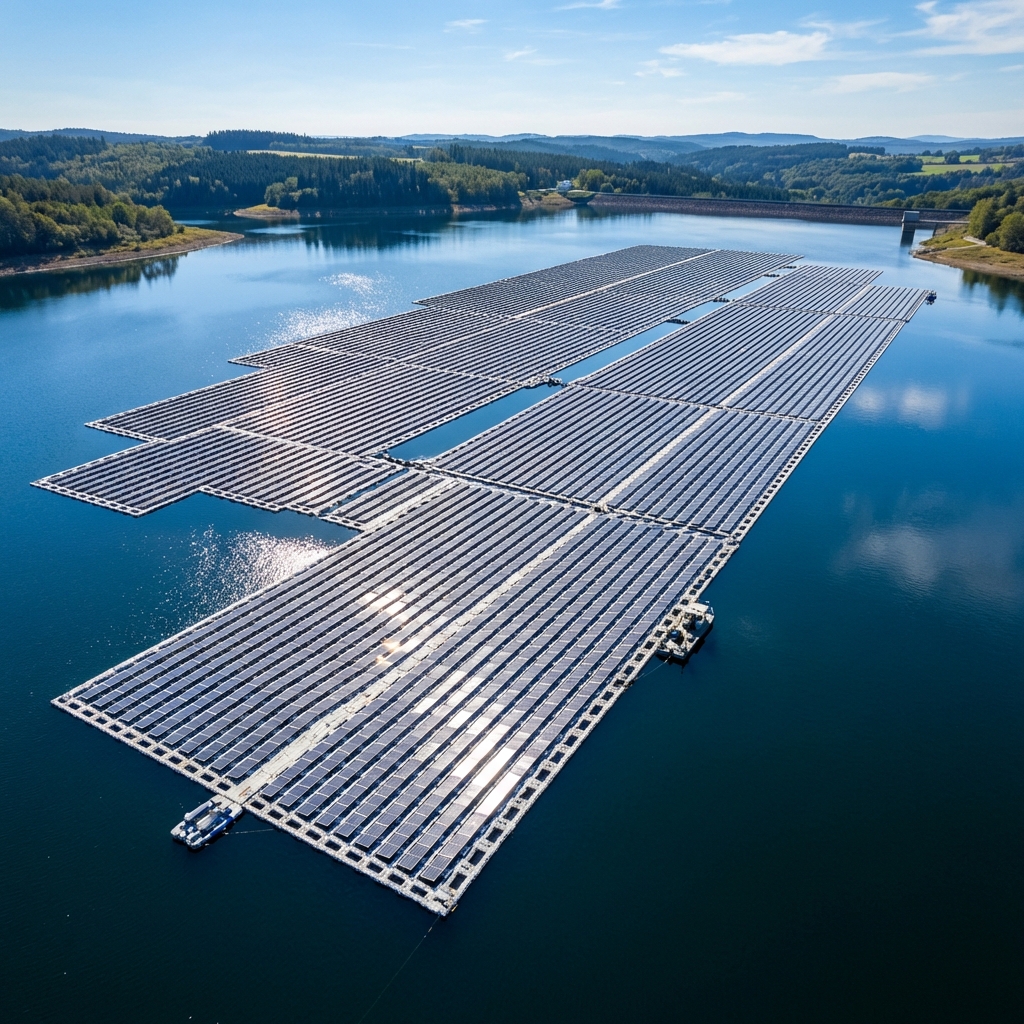
Floating photovoltaics (FPV) or "floatovoltaics" are solar panels mounted on buoyant structures that float on water bodies. The technology enables solar deployment on unused water surfaces while providing secondary benefits like reduced evaporation and algae control.
Floating Solar System Architecture
Floating vs Ground-Mounted Solar
| Aspect | Floating Solar | Ground-Mounted |
|---|---|---|
| Land Requirement | Zero (uses water) | 2.5-3 acres/MW |
| Panel Efficiency | +5-10% (cooling effect) | Baseline |
| CapEx | 10-15% higher | Lower |
| O&M Complexity | Specialized marine O&M | Standard |
| Environmental Impact | Reduces evaporation | Land conversion |
| Ideal For | Reservoirs, canals, lakes | Open land |
Advantages
Benefits of Floating Solar
Zero Land Use
Utilize water surface area without consuming valuable agricultural or industrial land.
Natural Cooling
Water provides natural cooling effect, improving panel efficiency by 5-10% vs ground-mounted.
Reduce Evaporation
Panel shading reduces water evaporation by 30-50%, conserving precious water resources.
Algae Control
Reduced sunlight penetration limits algae growth, improving water quality.
Higher Efficiency
Cooler operating temperatures mean better performance, especially in hot climates.
Hydro Synergy
Can be combined with existing hydro plants for hybrid generation and shared infrastructure.
Applications
Suitable Water Bodies
Floating solar can be deployed on various types of water bodies based on site conditions.
Industrial Reservoirs
Process Water Bodies
Cooling ponds, water treatment reservoirs, and industrial water storage. Perfect for captive power.
- Existing infrastructure
- Close to load center
- Industrial connectivity
- Own land/water
Best for: Manufacturing plants with water reservoirs
Irrigation Canals
Canal-Top Solar
Solar panels installed over irrigation canals. Popular in Gujarat (Narmada Canals).
- Linear installation
- Reduces evaporation
- No land acquisition
- Government canals
Best for: State irrigation projects
Lakes & Ponds
Natural Water Bodies
Municipal lakes, farm ponds, and natural water bodies suitable for floating installations.
- Large surface area
- Minimal civil work
- Environmental benefits
- Community projects
Best for: Municipal/community projects
System Design
Floating Solar Components
HDPE Floats/Pontoons
High-density polyethylene floating platforms engineered for 25+ year water exposure.
Solar PV Modules
Standard or bifacial modules with enhanced corrosion-resistant frames.
Anchoring System
Mooring lines and anchors to keep the floating array in position.
Inverters
String or central inverters, typically shore-mounted for easy access.
Underwater Cables
Submersible DC cables connecting floating array to shore inverters.
Grid Connection
Step-up transformer and grid interconnection equipment on shore.
Technical Specifications
| Floatation Material | HDPE (High-Density Polyethylene) |
| Design Life | 25+ years |
| Water Depth Required | Minimum 3 meters |
| Coverage Ratio | 70-80% of water surface |
| Panel Tilt | 10-15° (reduced for wind load) |
| Efficiency Gain | 5-10% vs ground-mounted |
| Evaporation Reduction | 30-50% |
| Typical Project Size | 1 MW - 100 MW |
How It Works
Development Process
Site Survey
Water body assessment, depth mapping, environmental study
Feasibility
Technical design, anchor points, grid connectivity
Approvals
Environmental clearance, water authority permits
Float Assembly
HDPE pontoon manufacturing and assembly on shore
Deployment
Float launching, module installation, cable laying
Commissioning
Grid sync, testing, remote monitoring setup