
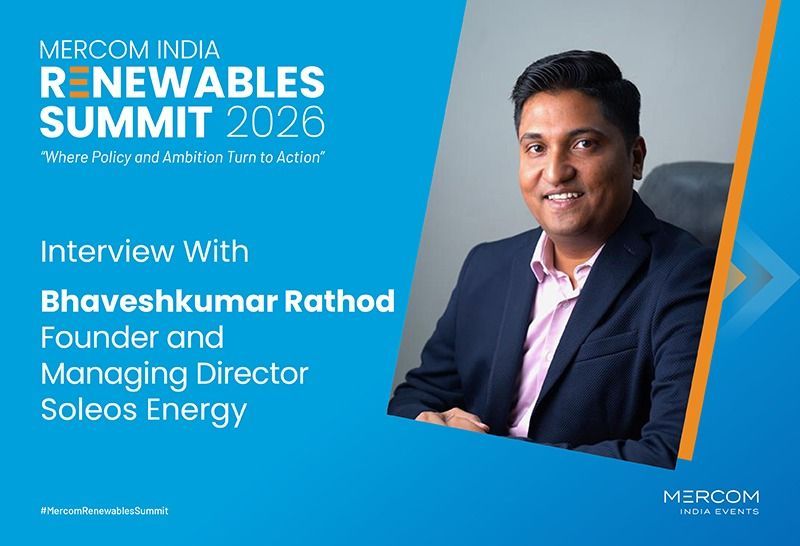
Bhavesh Kumar Rathod, Founder & Managing Director, Soleos Energy Limited
As renewable energy penetration rises, battery storage is becoming critical for addressing the intermittency of solar and wind, managing curtailment, and supplying firm power to consumers. At the same time, transmission constraints, right-of-way issues, domestic solar cell availability, and project financing timelines continue to affect project development.
Soleos Energy is an India-based renewable energy company providing end-to-end solutions across utility-scale, commercial & industrial (C&I), rooftop, floating solar, and energy storage projects.
On the sidelines of the Mercom India Renewables Summit 2026, Bhavesh Kumar Rathod, Founder & Managing Director of Soleos Energy, shared his views on domestic manufacturing, battery energy storage, open access, transmission bottlenecks, financing, and the company's long-term strategy for industrial decarbonization.
1. How are developers reassessing project viability amid uncertainty around module prices, domestic content requirements, and other regulatory changes?
The transition from non-DCR to DCR-compliant modules within six months was not entirely smooth, even though the government provided sufficient preparation time.
Developers who initially planned projects using lower-cost non-DCR modules faced significant cost increases when switching to DCR-compliant products.
While the transition has created short-term challenges, the market is expected to stabilize as domestic manufacturing expands.
2. What are the major challenges EPC companies currently face?
India currently has approximately:
- 175–200 GW of DCR-compliant module manufacturing capacity.
- Only 25–30 GW of domestic solar cell manufacturing capacity.
However, these figures represent nameplate capacity, not actual yearly production.
The biggest issue remains the imbalance between:
- High module manufacturing capacity
- Limited domestic solar cell availability
This mismatch creates procurement difficulties and delays project execution.
3. How is the expected implementation of ALMM List-II affecting projects?
Domestic production of ALMM List-II compliant solar cells remains limited.
While compliant modules may be available in smaller quantities, sourcing:
- 200 MW
- 300 MW
- Utility-scale requirements
is still difficult.
Limited cell availability is therefore impacting:
- Procurement planning
- EPC scheduling
- Project execution timelines
4. Storage is being viewed as the next major opportunity alongside solar and wind. What is your perspective?
Solar and wind are intermittent energy sources and cannot independently provide firm power.
Industrial consumers require reliable electricity, making Battery Energy Storage Systems (BESS) an essential component of renewable energy.
Storage addresses multiple challenges including:
- Renewable intermittency
- Curtailment
- Transmission congestion
- Round-the-clock power supply
Battery storage has become the common connecting technology across renewable energy systems.
Battery Cost Evolution
| Period | Approximate Cost |
|---|---|
| Earlier | ~$550/kWh |
| Current | ~$100/kWh |
Although battery prices have stabilized during the past 18 months, storage remains commercially viable.
In several applications, solar + storage has already reached grid parity.
Soleos Energy is also developing a large battery manufacturing facility to support this growing market.
5. How do you expect the Commercial & Industrial (C&I) Open Access market to evolve?
The C&I market has matured rapidly.
Industrial consumers continue adopting renewable energy because it offers:
- Lower electricity costs
- Predictable long-term tariffs
- Decarbonization opportunities
- Greater energy security
Demand is expected to remain strong over the next several years.
6. How are developers balancing execution timelines against land acquisition and transmission risks?
Two major bottlenecks continue affecting renewable projects:
Land
Possible improvements include:
- Better government support
- Easier access to government-owned land
- Improved engagement with landowners
- Fair compensation mechanisms
Transmission
Transmission remains a significantly larger challenge.
India requires substantial investment in transmission infrastructure.
This issue cannot be solved through policy changes alone and will require long-term infrastructure development.
7. What policy intervention is needed to address the transmission bottleneck?
Power evacuation remains one of India's largest renewable energy challenges.
Currently:
- States largely function as separate electricity markets.
- Interstate electricity movement is often complicated.
- Different policies exist across states.
Selling renewable electricity from one state to consumers in another remains difficult, especially at lower voltage levels.
Suggested Improvements
- Better interstate transmission connectivity
- More transparent electricity markets
- Uniform regulations across states
- Easier movement of renewable power from surplus to deficit regions
European electricity markets provide examples where even small producers can freely sell electricity into the grid.
8. What is your assessment of Maharashtra's Time-of-Day Banking framework?
The policy is considered directionally positive.
It reflects the lower value of electricity generated during daytime solar hours while encouraging battery storage adoption.
However:
- Several implementation orders are still pending.
- Developers and consumers may experience short-term operational challenges.
In the long term, the framework is expected to:
- Improve grid management
- Increase battery storage deployment
9. What regulatory changes would improve renewable project execution?
Highest Priorities
- Better connectivity support
- Faster transmission approvals
- Clear right-of-way framework
Right-of-way disputes continue delaying many large renewable projects.
The government should establish policies that:
- Protect landowners
- Reduce project delays
- Enable timely transmission development
Storage Policy
Battery storage should not be evaluated independently.
Instead:
- Solar
- Wind
- Battery Storage
should collectively be treated as firm renewable capacity.
Financial Market Reforms
Projects selling electricity on exchanges face revenue uncertainty.
Possible policy solutions include:
- Contracts for Difference (CfD)
- Floor pricing mechanisms
- Revenue support structures
These measures could significantly improve project bankability and financing.
10. Is financing still a constraint for renewable energy projects?
Capital availability itself is not the primary concern.
More important issues include:
- Financing timelines
- Cost of capital
- Loan tenure
- Flexible financing structures
Many lenders continue expecting rigid take-or-pay agreements.
Renewable financing would improve if lenders adopted a more partnership-oriented approach with greater understanding of renewable business models.
11. How does Soleos Energy plan to contribute to India's renewable energy growth?
Soleos Energy continues focusing on:
- New technologies
- New markets
- Solving industrial energy challenges
The company aims to accelerate industrial decarbonization through:
- Solar Energy
- Wind Energy
- Battery Energy Storage
- Other clean energy technologies
Long-term renewable power agreements provide industries with:
- Stable electricity prices
- Reduced dependence on fluctuating grid tariffs
- Better long-term financial planning
- Improved sustainability
Soleos Energy plans to continue delivering integrated renewable energy solutions across India and international markets.
- Domestic module manufacturing has expanded rapidly, but solar cell availability remains a major bottleneck.
- ALMM List-II implementation presents procurement challenges due to limited compliant cell supply.
- Battery Energy Storage Systems (BESS) are becoming essential for reliable renewable power.
- Battery costs have declined from approximately $550/kWh to nearly $100/kWh, making storage commercially viable.
- Transmission infrastructure and right-of-way remain India's biggest execution challenges.
- The C&I Open Access market continues to show strong long-term growth.
- Regulatory reforms such as improved connectivity, right-of-way policies, and Contracts for Difference (CfD) could significantly improve project execution and financing.
- Soleos Energy aims to support industrial decarbonization through integrated solar, wind, and energy storage solutions in India and global markets.